
Posted At: Jul 07, 2026 - 564 Views
Mechanical Seal vs Lip Seal: Key Differences Explained
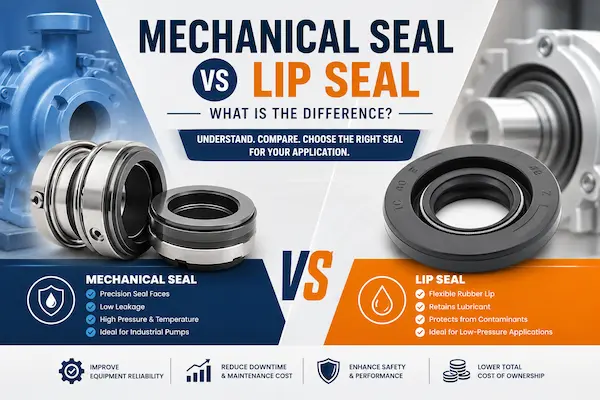
Now that you understand how each seal works, let's compare them side by side. Although both are designed to prevent leakage around a rotating shaft, they differ in construction, performance, maintenance requirements, and operating conditions.
Mechanical Seal vs Lip Seal: Comparison Table
| Feature | Mechanical Seal | Lip Seal |
|---|---|---|
| Working Principle | Uses two precision seal faces in contact | Uses an elastomeric lip against the shaft |
| Leakage | Extremely low leakage | Minor leakage is normal over time |
| Pressure Handling | Suitable for high-pressure systems | Best for low-pressure applications |
| Temperature Range | Performs well in high temperatures | Limited by rubber material properties |
| Shaft Speed | Excellent for high-speed rotating equipment | Best for moderate shaft speeds |
| Fluid Compatibility | Chemicals, acids, solvents, oils, slurries | Mainly lubricating oil and grease |
| Contamination Protection | Excellent | Good |
| Maintenance | Longer service intervals | Requires periodic replacement |
| Initial Cost | Higher | Lower |
| Operating Cost | Lower over the equipment lifecycle | Can become higher due to frequent replacement |
| Service Life | Long | Moderate |
| Typical Industries | Chemical, pharmaceutical, food processing, oil & gas, power plants | Automotive, gearboxes, electric motors, agricultural equipment |
12 Major Differences Between Mechanical Seal and Lip Seal
1. Sealing Method
The biggest difference between a mechanical seal and a lip seal is how they create the sealing barrier.
A mechanical seal uses two precision-machined seal faces that rotate against each other while maintaining an extremely thin lubricating film.
A lip seal relies on a flexible rubber lip that continuously contacts the rotating shaft.
2. Leakage Performance
Mechanical seals are specifically designed to minimize product leakage.
In industries such as pharmaceuticals, food processing, petrochemicals, and chemical manufacturing, even a small leak can create safety hazards and production losses.
Lip seals are not intended to provide zero leakage. Instead, they primarily retain lubricants inside equipment.
3. Pressure Capability
One of the biggest advantages of mechanical seals is their ability to operate under high pressures.
Many industrial pumps operate well above the pressure limits of conventional lip seals.
Lip seals perform best under low-pressure conditions.
4. Temperature Resistance
Mechanical seals are manufactured using advanced materials such as:
Silicon Carbide
Tungsten Carbide
Carbon Graphite
Ceramic
These materials allow them to perform reliably under elevated temperatures.
Lip seals depend on elastomers like:
Nitrile (NBR)
Viton (FKM)
EPDM
Silicone
These materials have temperature limitations.
5. Chemical Resistance
Mechanical seals are widely used for handling:
Acids
Alkalis
Solvents
Toxic chemicals
Corrosive fluids
Abrasive slurries
Lip seals may degrade when exposed to aggressive chemicals unless a compatible elastomer is selected.
6. Installation Complexity
Lip seals are simple to install and usually require minimal alignment.
Mechanical seals demand proper installation, shaft alignment, and careful handling to ensure reliable performance.
Incorrect installation can shorten seal life.
7. Cost
The purchase price of a lip seal is considerably lower.
Mechanical seals involve precision engineering and higher-quality materials, resulting in a higher upfront investment.
However, the total cost of ownership often favors mechanical seals because of reduced downtime and maintenance.
8. Maintenance Requirements
Mechanical seals generally require less frequent replacement when installed and operated correctly.
Lip seals experience continuous rubbing against the shaft, causing gradual wear.
This often leads to more frequent maintenance.
9. Equipment Efficiency
Mechanical seals generate less friction compared to traditional packing methods and help reduce product loss through leakage.
Efficient sealing contributes to better pump performance and lower operating costs.
Lip seals create continuous contact friction between the sealing lip and shaft.
10. Shaft Wear
Since lip seals maintain constant contact with the shaft, grooves may develop over time.
Mechanical seals experience wear primarily at the seal faces rather than on the shaft itself.
11. Typical Applications
Mechanical Seals
Mechanical seals are commonly used in:
- Chemical processing plants
- Oil and gas facilities
- Pharmaceutical manufacturing
- Food and beverage processing
- Water treatment plants
- Power generation
- Mining operations
- Industrial centrifugal pumps
- Mixers and agitators
Lip Seals
Lip seals are commonly found in:
- Gearboxes
- Automotive engines
- Wheel hubs
- Electric motors
- Bearings
- Agricultural machinery
- Conveyor systems
- Hydraulic cylinders
12. Service Life
Under proper operating conditions, a mechanical seal generally lasts much longer than a lip seal.
Its service life depends on:
Proper installation
Correct seal selection
Fluid properties
Operating conditions
Maintenance practices
Lip seals naturally wear due to continuous shaft contact and usually require replacement more often.
Advantages of Mechanical Seals
Mechanical seals offer several performance benefits for demanding industrial applications.
✔ Extremely low leakage
Ideal for hazardous, expensive, and environmentally sensitive fluids.
✔ Longer service life
Designed for continuous industrial operation with minimal wear.
✔ Better energy efficiency
Reduced leakage and optimized sealing improve overall pump efficiency.
✔ High-pressure capability
Suitable for demanding process applications.
✔ Handles aggressive chemicals
Available in a wide range of corrosion-resistant materials.
✔ Lower maintenance costs
Fewer replacements mean reduced downtime and lower lifecycle expenses.
Advantages of Lip Seals
Lip seals remain a practical choice for many standard industrial applications.
✔ Cost-effective
Affordable for high-volume machinery.
✔ Easy installation
Simple replacement with minimal tools.
✔ Compact design
Fits into small equipment with limited installation space.
✔ Excellent lubricant retention
Helps protect bearings and rotating components.
✔ Effective contamination barrier
Keeps dirt, moisture, and dust away from internal components.
Mechanical Seal vs Lip Seal: Which One Should You Choose?
The right sealing solution depends on your operating environment and equipment requirements.
Choose a mechanical seal if you need:
High-pressure performance
High-temperature resistance
Minimal leakage
Long service life
Chemical compatibility
Reliable sealing for industrial pumps
Choose a lip seal if your application involves:
Low-pressure systems
Lubricant retention
Simple machinery
Budget-conscious maintenance
Moderate operating temperatures
General-purpose rotating equipment
There is no one-size-fits-all solution. Evaluating factors such as fluid type, pressure, shaft speed, operating temperature, and maintenance expectations will help you select the most suitable seal.
Conclusion
When comparing Mechanical Seal vs Lip Seal, the right choice depends on your equipment, operating conditions, and sealing requirements.
A mechanical seal is the ideal solution for applications involving high pressure, elevated temperatures, aggressive chemicals, and critical process reliability. It offers superior leakage control, longer service life, and reduced maintenance, making it the preferred choice for industrial pumps and process equipment.
A lip seal, on the other hand, is a practical and cost-effective option for retaining lubricants and protecting rotating components in lower-pressure applications. Its simple design, easy installation, and affordability make it well suited for gearboxes, electric motors, bearings, and general machinery.
Before selecting a seal, consider key factors such as operating pressure, fluid type, shaft speed, temperature, and maintenance requirements. Choosing the correct sealing solution can improve equipment reliability, reduce downtime, and lower long-term operating costs.
Why Choose QMSeals?
At QMSeals, we manufacture high-performance mechanical sealing solutions designed to meet the demanding needs of modern industries. Our products are engineered for durability, efficiency, and dependable performance across a wide range of applications.
Our product portfolio includes:
- Cartridge Mechanical Seals
- Component Mechanical Seals
- Metal Bellows Seals
- Rubber Bellows Seals
- Agitator Seals
- Multi-Spring Mechanical Seals
- Single Spring Mechanical Seals
- Custom Engineered Sealing Solutions
Whether you require a standard replacement seal or a customized sealing solution, our experienced team can help you select the right product for your application.
Contact QMSeals today to find the ideal mechanical seal for your pumps and rotating equipment.

