
Posted At: Sep 22, 2026 - 242 Views
Mechanical Seal Replacement for Pumps: How to Select the Correct Seal
A leaking pump mechanical seal is often treated as a simple spare-parts problem: remove the old seal, measure the shaft, order a replacement and install it.
That approach can work for a known standard seal in a clean, low-risk application. However, it can also lead to repeat leakage, premature wear, installation problems or an unsuitable material combination.
A mechanical seal is selected for both the equipment and the operating conditions. Shaft or sleeve diameter is important, but it is only one part of the decision. The pump model, seal chamber, working length, stationary seat, fluid, temperature, pressure, speed, materials and seal arrangement may all affect compatibility.
This guide explains how to approach a mechanical seal replacement and what information to provide to a manufacturer or supplier before requesting a quotation.
What Does a Mechanical Seal Do?
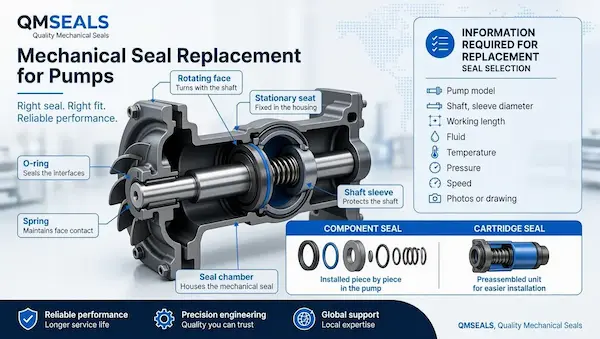
A mechanical seal prevents process fluid from escaping where a rotating pump shaft passes through the stationary casing. It normally uses two closely matched faces:
- A rotating face
- A stationary face or seat
- Secondary seals such as O-rings or bellows
- Springs or another loading mechanism
- Metallic components
- A gland, sleeve or cartridge assembly, depending on the design
The seal faces must remain in controlled contact while accommodating shaft rotation, thermal effects and limited movement. A thin fluid film between the faces helps reduce friction and heat. If that lubrication film is lost, the faces can overheat and fail quickly.
The seal is therefore part of a system. Correct face contact alone cannot compensate for poor shaft condition, inadequate flush, misalignment, dry running or incompatible elastomers.
Why Do Pump Mechanical Seals Fail?
A failed seal does not always indicate that the seal was the wrong product. The cause may be related to installation, equipment condition or the operating environment.
Before ordering the next seal, investigate the operating conditions and the reason for the original failure. A direct replacement may not solve a problem caused by equipment movement or an unsuitable seal environment.
Which Type of Mechanical Seal May Be Required?
QMSEALS supplies several categories of mechanical seals, but the correct category depends on the pump and service.
These categories are not interchangeable labels. Two seals with the same nominal shaft size may have different working lengths, seats, drive arrangements, spring positions or pressure capabilities.
How to Select a Mechanical Seal Replacement
A reliable selection normally starts with four groups of information.
1. Equipment information
Identify the machine receiving the seal:
- Pump make
- Pump model
- Pump series or size
- Horizontal, vertical or submersible arrangement
- Pump type
- Shaft or shaft-sleeve diameter
- Seal chamber dimensions
- Existing seal part number, if available
A pump model can be particularly useful when the original seal was supplied as an OEM assembly or when the equipment uses a model-specific seat and working length.
2. Dimensional information
The most useful dimensions may include:
- Shaft or sleeve diameter
- Seal bore and outside diameter
- Overall working length
- Rotating assembly length
- Stationary seat dimensions
- Seat type and orientation
- Gland or cover dimensions
- Drive slot, pin or anti-rotation details
- Distance to the first obstruction
- Available axial space
Do not assume that a seal with the correct bore will fit the seal chamber. The stationary seat, gland arrangement and axial working length must also be compatible.
3. Operating information
Provide the actual or expected operating conditions:
- Fluid or process media
- Fluid concentration
- Temperature
- Pressure at the seal chamber
- Pump speed or RPM
- Fluid viscosity
- Presence of solids, crystals or abrasive particles
- Corrosive or hazardous characteristics
- Startup, shutdown and intermittent operating conditions
For example, a clean-water seal and a chemical-pump seal may have similar dimensions but require different face and elastomer materials. A slurry service may need a different design from a clean process fluid because solids can abrade faces or obstruct springs.
4. Seal-support information
Some applications require more than the seal itself. Confirm whether the pump uses:
- Flush
- Quench
- Cooling
- Lubrication
- Buffer fluid
- Barrier fluid
- A reservoir or support system
- Filtration or cyclone separation
- External circulation
A double seal, for example, may be selected with a barrier or buffer arrangement. The support system and its pressure, fluid and circulation conditions should be reviewed with the seal design.
Why Shaft Diameter Alone Is Not Enough
Shaft diameter is one of the first measurements buyers usually provide, and it is useful for narrowing the options. It does not by itself identify a complete replacement seal.
The following seals could share a nominal bore while differing in important ways:
- Stationary seat dimensions
- Working length
- Seal chamber fit
- Spring configuration
- Face materials
- Elastomers
- Pressure suitability
- Temperature suitability
- Drive arrangement
- Single or double arrangement
- Cartridge or component construction
This is why a quotation request should include the pump model, old seal photographs, dimensional sketches or a drawing whenever possible.
Component Seal or Cartridge Seal?
A component seal is supplied as separate parts that are assembled and set during installation. It may be appropriate where the maintenance team has the necessary experience and the equipment is designed around a standard component arrangement.
A cartridge seal is supplied as a pre-assembled unit. Its setting and component alignment are controlled before installation, which can help reduce some assembly and setting errors. It may also simplify replacement work, although the cartridge still needs to match the pump chamber, shaft, gland and operating conditions.
Neither configuration is automatically correct for every pump. The equipment and maintenance requirements should guide the choice.
When Is a Single or Double Seal Appropriate?
A single mechanical seal may be suitable when the process fluid can provide adequate face lubrication and the consequences of minor leakage are acceptable within the application.
A double seal may be considered when:
- The process fluid is hazardous or environmentally sensitive
- Additional containment is required
- The fluid is poorly lubricating
- The fluid can crystallize or solidify at the faces
- A barrier or buffer fluid is needed
- The application requires a controlled seal environment
The decision depends on the complete application. A double seal also requires suitable auxiliary arrangements, operating procedures and monitoring. It should not be specified simply because it appears more robust.
Selecting Seal Faces and Elastomers
Face materials are chosen according to the fluid, solids, temperature, pressure, speed and expected lubrication conditions.
Common face-material terminology in the industry includes:
- Carbon
- Ceramic
- Silicon carbide
- Tungsten carbide
The correct combination depends on the service. Abrasive fluids, corrosive chemicals and poor lubrication may require different combinations. A hard face is not automatically the answer if the counterface, fluid chemistry or operating conditions are unsuitable.
Elastomers and secondary seals must also be compatible with the process media and temperature. Depending on the application, the design may use an elastomer such as an appropriate fluoroelastomer, EPDM or another specified material. The final choice should be confirmed against the actual fluid and temperature rather than selected from a generic list.
Abrasive, Slurry and Chemical Services
Slurry pump seals require special attention to particle size, solids concentration, abrasiveness and the possibility of solids entering or building up around the seal.
Questions to clarify include:
- Is the slurry continuous or intermittent?
- Are the solids sharp, fibrous or crystalline?
- Is clean flush water available?
- Can the process tolerate dilution?
- What materials are exposed to the fluid?
- Does the seal need to operate with or without an external flush?
Chemical pump applications require similar discipline. Identify the chemical, concentration, temperature and pressure. If the fluid changes during cleaning or process transitions, include those conditions as well.
What Information Do You Need to Order the Correct Mechanical Seal?
Send as much of the following information as possible when requesting a quotation.
If you do not know every specification, that should not prevent you from making an enquiry. A clear photograph of the existing seal, measured dimensions, the pump model, a drawing or a physical sample may provide enough information for an initial review.
When Is a Custom Mechanical Seal Required?
A custom seal may be appropriate when:
- The pump is old or discontinued
- The original seal is unavailable
- The seal chamber has non-standard dimensions
- The pump has been modified
- The application requires unusual materials
- The equipment uses a special seat or working length
- A standard seal has repeatedly failed
- The seal is for an agitator, reactor or mixer with a special mounting arrangement
A custom design should begin with verified drawings, samples, dimensions and operating data. The more complete the information, the easier it is to identify what can be retained from the existing design and what needs to change.
Installation Checks Before Startup
Even a correctly selected seal can fail during installation. Before startup:
- Confirm the shaft or sleeve is clean and free from burrs
- Check for scoring, corrosion and excessive wear
- Inspect the seal chamber and stationary-seat location
- Clean the seal faces without scratching them
- Protect O-rings and bellows from cuts or twisting
- Confirm the seal setting and working length
- Check gland alignment and fastener tightening
- Verify flush, quench, cooling or barrier connections
- Ensure the pump is properly filled and the seal is not started dry
- Check shaft alignment, bearing condition and excessive vibration
Follow the applicable installation instructions for the selected seal. If the pump has adjustable impeller or shaft positioning, confirm that the adjustment will not exceed the seal’s available movement.
How QMSEALS Can Support a Replacement Enquiry
QMSEALS – Quality Mechanical Seals – manufactures and supplies mechanical seals and related sealing products for industrial buyers, pump users, OEMs, distributors and maintenance teams.
Relevant product categories include cartridge, single, double, conical spring, agitator, bellow, heavy-duty, slurry pump and custom mechanical seals, along with industrial gaskets and pump spare parts.
The most efficient way to begin is to send the pump model, existing seal details, dimensions, drawing, sample or clear photographs together with the operating conditions. This allows the application to be reviewed before a replacement is proposed.
Buyer Enquiry Checklist
Frequently Asked Questions?
How do I choose the correct mechanical seal for my pump?
Start with the pump make and model, shaft or sleeve diameter, seal dimensions, fluid, temperature, pressure, speed and existing seal arrangement. Shaft diameter alone is not enough to identify a complete replacement.
Can a mechanical seal be manufactured from a sample?
In many cases, a manufacturer can evaluate an existing seal from a physical sample, photographs and measured dimensions. The sample should be accompanied by the pump and operating information so that the replacement is not based on geometry alone.
Can one manufacturer’s seal replace an OEM seal?
An equivalent or aftermarket seal may be possible, but compatibility must be verified. Compare the seal chamber, working length, stationary seat, drive arrangement, materials and operating conditions before approving the replacement.
What is the difference between a cartridge seal and a component seal?
A component seal is assembled and set during installation. A cartridge seal is supplied as a pre-assembled unit. Cartridge construction can simplify installation, but it still must match the pump and seal chamber dimensions.
When should a double mechanical seal be considered?
A double seal may be considered for hazardous, poorly lubricating, crystallizing, abrasive or environmentally sensitive fluids, or where a barrier or buffer fluid is required. The complete support arrangement must also be evaluated.
What causes a new mechanical seal to leak?
Common causes include dry running, damaged faces, incorrect setting, misalignment, shaft damage, vibration, inadequate flush, incompatible elastomers and incorrect seal-chamber dimensions.
Can QMSEALS supply slurry pump mechanical seals?
QMSEALS lists slurry pump mechanical seals among its product categories. The slurry’s solids, abrasiveness, concentration, temperature, pressure and flush conditions should be provided for proper review.
Can QMSEALS manufacture a custom mechanical seal?
Custom mechanical seals may be considered for unusual dimensions, discontinued equipment, special materials, agitators, reactors or applications where a standard seal is unsuitable. Drawings, samples and operating data help determine feasibility.
Need Help With Mechanical Seal Replacement?
If you need help identifying or sourcing a mechanical seal, send QMSEALS your pump model, existing seal details, dimensions, drawing or clear photographs.
If available, also include the fluid, temperature, pressure, speed, seal arrangement and quantity required. If the complete specification is not known, an existing seal or sample can help begin the evaluation.
QMSEALS
Quality Mechanical Seals
Website: qmseals.com
Email: sales@qmseals.com
Phone: +91 9787978714

