
Posted At: Apr 13, 2026 - 922 Views
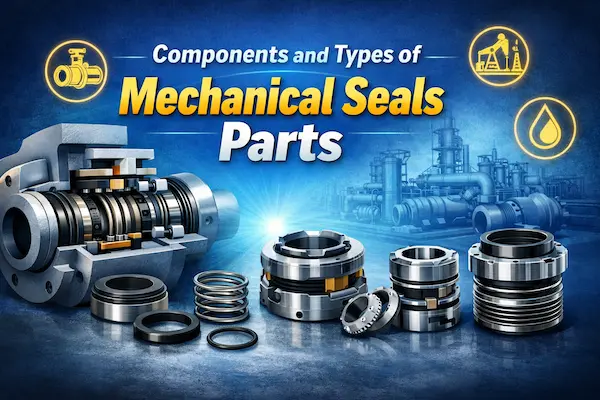
Components and Types of Mechanical Seals Parts: A Complete Guide
In the world of industrial fluid handling, the difference between a high-performing system and a costly failure often comes down to a few millimeters of precision engineering. Whether you are operating a centrifugal pump in a chemical plant or a high-speed mixer in a pharmaceutical facility, understanding the parts of mechanical seal systems is essential for operational reliability.
At QMSeals, we specialize in both standard and customized sealing solutions. In this guide, we will break down the fundamental components and the various types of mechanical seals to help you make informed decisions for your equipment.
What Exactly is a Mechanical Seal?
A mechanical seal is a leakage control device found on rotating shafts, such as those in pumps and compressors. Its primary job is to keep the process fluid (liquid or gas) inside the equipment while preventing contaminants from entering.
Unlike traditional gland packing, which relies on friction and controlled leakage, mechanical seals provide a near-leak-proof environment, significantly reducing maintenance costs and energy consumption.
Core Components: Understanding Mechanical Seal Parts
To maintain a perfect seal under high pressure and temperature, several mechanical seal parts must work in harmony. While designs vary, most seals consist of these five primary elements:
1. The Rotating Primary Face
This part is fixed to the shaft and rotates at the same speed. It is usually made of a harder material like Silicon Carbide or Tungsten Carbide.
2. The Stationary Primary Face
This face is fixed to the pump housing (stuffing box) and does not move. The "seal" is formed at the microscopic gap between this stationary face and the rotating face.
3. Mechanical Loading Devices (Springs)
To keep the two faces in constant contact, even when the pump is not running, mechanical loading is required. Common mechanical seal parts names for loading include:
Single Coil Springs: Ideal for dirty fluids.
Multi-Springs: Provide even pressure across the seal face.
Metal Bellows: Used for high-temperature applications where elastomers might fail.
4. Secondary Sealing Elements (O-Rings & Gaskets)
These prevent leakage between the seal components and the shaft or housing. At QMSeals, we offer various materials like Viton, EPDM, and PTFE (V-Packings) to ensure chemical compatibility.
5. Drive Mechanisms
Components like set screws, drive pins, or drive lugs that transmit the rotation of the shaft to the rotating seal face.
Common Types of Mechanical Seal
Selecting the right types of mechanical seal depends on your specific application, fluid properties, and pressure requirements.
1. Cartridge Seals (The Industry Standard)
A cartridge mechanical seal is a pre-assembled unit that includes the gland, sleeve, and faces.
Advantage: Fast installation and zero "setting" errors.
Best for: Most industrial pumps where downtime must be minimized.
2. Component Seals
These are individual parts installed one by one. While more cost-effective, they require highly skilled technicians to ensure correct alignment and spring tension.
3. Bellows Seals (Metal & Elastomer)
Bellows seals eliminate the need for dynamic O-rings, which can often hang up or wear down the shaft.
Metal Bellows: Excellent for extreme temperatures (hot oil or cryogenic).
Elastomer Bellows: Great for general-purpose water pumps.
4. Air Seals
A non-contacting solution that uses a thin film of air or inert gas to create a barrier. These are primarily used for dry powders and slurries.
The Role of a Mechanical Seal in Pump Systems
Why is the mechanical seal in pump operations so critical? In a centrifugal pump, the shaft passes through the "stuffing box." Without a seal, the pressurized fluid would escape along the shaft.
A high-quality QMSeals mechanical seal ensures:
Reduced Product Loss: Essential for expensive chemical or pharma ingredients.
Safety: Prevents hazardous or toxic leaks into the environment.
Bearing Protection: Prevents leaked fluid from entering the bearing housing, which could cause catastrophic pump failure.
Why Choose QMSeals for Your Sealing Needs?
Choosing the right mechanical seal parts is only half the battle; you also need the right partner. Since 2009, QMSeals has been a leader in manufacturing high-performance seals for 2,000+ global clients.
Customization: We don’t just sell seals; we engineer solutions for your specific pressure, temperature, and chemical challenges.
Material Excellence: From Carbon and Ceramic to Sintered Silicon Carbide, we use only the highest-grade materials.
Global Support: With branches across India and exports to over 11 countries, we provide technical assistance wherever you are.
Conclusion
Understanding the parts of mechanical seal and the different types of mechanical seal is essential for optimizing pump performance and preventing costly failures. From rotating faces to advanced cartridge designs, each component plays a vital role in ensuring a leak-free system.
Frequently Asked Questions
1. What are the main parts of mechanical seal?
The main components include rotating face, stationary face, secondary seals, springs, drive mechanism, and gland plate.
2. What are the types of mechanical seal?
Common types include cartridge seals, component seals, air seals, pusher and non-pusher seals, and balanced/unbalanced seals.
3. What is the most common cause of mechanical seal failure?
Most failures are caused by improper installation or "dry running," where the seal faces lose lubrication and overheat.
4. How do I identify my mechanical seal parts name?
You can refer to the manufacturer's drawing. Common parts include the Rotary Face, Stationary Seat, O-rings, Springs, and Sleeve.
5. Can a mechanical seal be repaired?
Yes! QMSeals offers professional reconditioning services, including face lapping and secondary seal replacement, to restore your seal to "as new" condition.

