
Posted At: Jan 27, 2026 - 958 Views
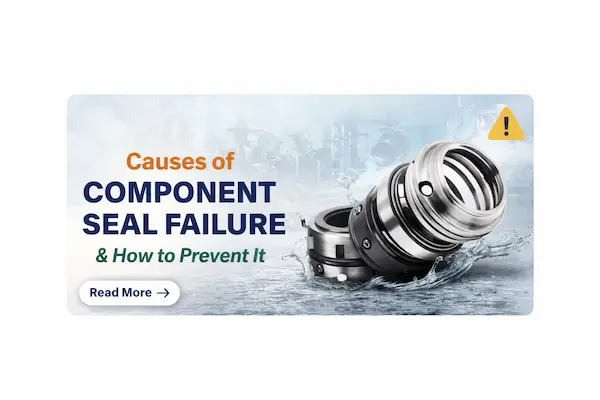
Causes of Component Seal Failure & How to Prevent Them
Component mechanical seals are widely used in industrial pumps due to their flexibility, cost-effectiveness, and suitability for a wide range of operating conditions. However, despite their advantages, component seal failure remains one of the most common reasons for pump leakage, unplanned downtime, and maintenance costs in industrial applications.
Understanding the causes of component seal failure and knowing how to prevent them is critical for improving pump reliability, extending seal life, and ensuring safe plant operations. In this blog, we’ll break down the most common reasons for component mechanical seal failure and share proven preventive practices used across industries.
What Is a Component Mechanical Seal?
A component mechanical seal is a sealing arrangement made up of individual parts such as the rotating face, stationary face, springs, elastomers, and hardware, assembled directly on the pump shaft during installation. Unlike cartridge seals, component seals require precise installation and alignment, making correct handling and expertise essential.
Component seals are commonly used in:
- Centrifugal pumps
- Chemical process pumps
- Water and wastewater pumps
- Oil & gas and general industrial applications
Their performance heavily depends on correct selection, installation, and operating conditions.
Why Do Component Mechanical Seals Fail?
Component mechanical seals rarely fail due to a single reason. In most cases, failure is caused by a combination of mechanical, thermal, operational, and material-related factors. Below are the most common causes of component seal failure observed in industrial pumps.
1. Improper Installation of Component Seals
Improper installation is one of the leading causes of component mechanical seal failure. Since component seals are assembled part by part on-site, even a small error can result in premature leakage.
Common installation mistakes include:
Incorrect setting length
Uneven tightening of gland bolts
Damage to seal faces during handling
Improper spring compression
How to Prevent It:
Always follow manufacturer installation guidelines
Use proper tools and clean working conditions
Ensure correct shaft sleeve condition and surface finish
Train maintenance personnel specifically for component seal installation
2. Dry Running Conditions
Dry running occurs when a pump operates without sufficient fluid at the seal faces. Component seals are especially sensitive to this condition, as they rely on the pumped fluid for lubrication and cooling.
Effects of dry running:
Rapid overheating of seal faces
Cracked carbon faces
Elastomer hardening or melting
How to Prevent It:
Ensure pumps are fully primed before startup
Use level switches or dry-run protection systems
Select seal materials suitable for short dry-run tolerance when required
3. Shaft Misalignment and Excessive Runout
Shaft misalignment or excessive shaft runout creates uneven contact between seal faces, leading to accelerated wear and leakage.
Common causes include:
Bent shafts
Improper coupling alignment
Bearing failure
How to Prevent It:
Regularly inspect pump bearings and shafts
Maintain correct coupling alignment
Measure shaft runout during maintenance
4. Incorrect Seal Material Selection
Using the wrong seal face material or elastomer is a major contributor to component seal failure in industrial pumps, especially in chemical and high-temperature applications.
Examples:
Using carbon faces in abrasive fluids
Selecting incompatible elastomers for chemical media
Ignoring temperature and pressure limits
How to Prevent It:
Match seal face materials (Carbon, Silicon Carbide, Tungsten Carbide) to application conditions
Choose elastomers (Viton, EPDM, PTFE) based on fluid compatibility
Consult experienced seal manufacturers like QMSEALS for proper selection
5. Excessive Pressure and Temperature
Operating beyond the design limits of a component mechanical seal causes face distortion, thermal cracking, and elastomer degradation.
Common sources of high pressure or temperature:
Dead-heading of pumps
Blocked discharge lines
Inadequate cooling or flushing
How to Prevent It:
Ensure pumps operate within design parameters
Use appropriate flush plans or cooling arrangements
Monitor pressure and temperature continuously
6. Abrasive or Corrosive Process Fluids
Abrasive particles can cause rapid seal face wear, while corrosive fluids attack metal parts and elastomers, leading to seal failure.
How to Prevent It:
Use hard face materials like Silicon Carbide or Tungsten Carbide
Apply external flush systems for abrasive services
Select corrosion-resistant metallurgy for seal hardware
7. Poor Maintenance Practices
Lack of routine inspection and delayed maintenance often results in small seal issues turning into major failures.
Warning signs often ignored:
Minor leakage
Abnormal noise or vibration
Increased seal chamber temperature
How to Prevent It:
Establish regular inspection schedules
Replace worn components proactively
Maintain clean seal chambers
Common Signs of Component Seal Failure
Identifying early symptoms can prevent catastrophic pump damage. Common signs include:
- Visible leakage from the seal area
- Sudden increase in seal temperature
- Abnormal pump vibration or noise
- Reduced pump efficiency
How to Prevent Component Seal Failure – Best Practices
Preventing component seal failure requires a holistic approach:
- Correct seal selection for the application
- Skilled installation and handling
- Regular monitoring and inspection
- Proper flushing and cooling systems
- Partnering with a reliable seal manufacturer
At QMSEALS, component seals are designed with application-specific materials and precision engineering to ensure long service life and dependable performance across industries.
Component Seal Failure vs Cartridge Seal Failure
While cartridge seals reduce installation errors, component seals remain preferred in many applications due to flexibility and cost advantages. However, component seals demand higher installation accuracy and maintenance discipline. Choosing between them depends on operating conditions, maintenance capabilities, and lifecycle cost considerations. Click here to understand the difference between component seals and cartridge seals.
Why Choosing the Right Seal Manufacturer Matters
A high-quality component mechanical seal combined with expert technical support can significantly reduce seal failure incidents. QMSEALS offers:
- Application-engineered component seals
- Material compatibility guidance
- Technical support for selection and installation
- Reliable sealing solutions for industrial pumps
Conclusion
Component seal failure is not inevitable. By understanding the root causes and implementing preventive measures, industries can drastically reduce downtime, maintenance costs, and pump failures. Proper seal selection, correct installation, and regular monitoring are the keys to long-lasting seal performance.
For reliable and application-specific component mechanical seals, QMSEALS stands as a trusted partner for industrial sealing solutions.
Frequently Asked Questions
What is the most common cause of component seal failure?
Improper installation and dry running are the most common causes.
Can component seal failure be repaired?
In many cases, damaged faces or elastomers must be replaced rather than repaired.
How long should a component mechanical seal last?
Seal life depends on application conditions, but proper selection and maintenance can significantly extend service life.

