
Posted At: Sep 08, 2026 - 345 Views
Cartridge Seal Manufacturer and Supplier
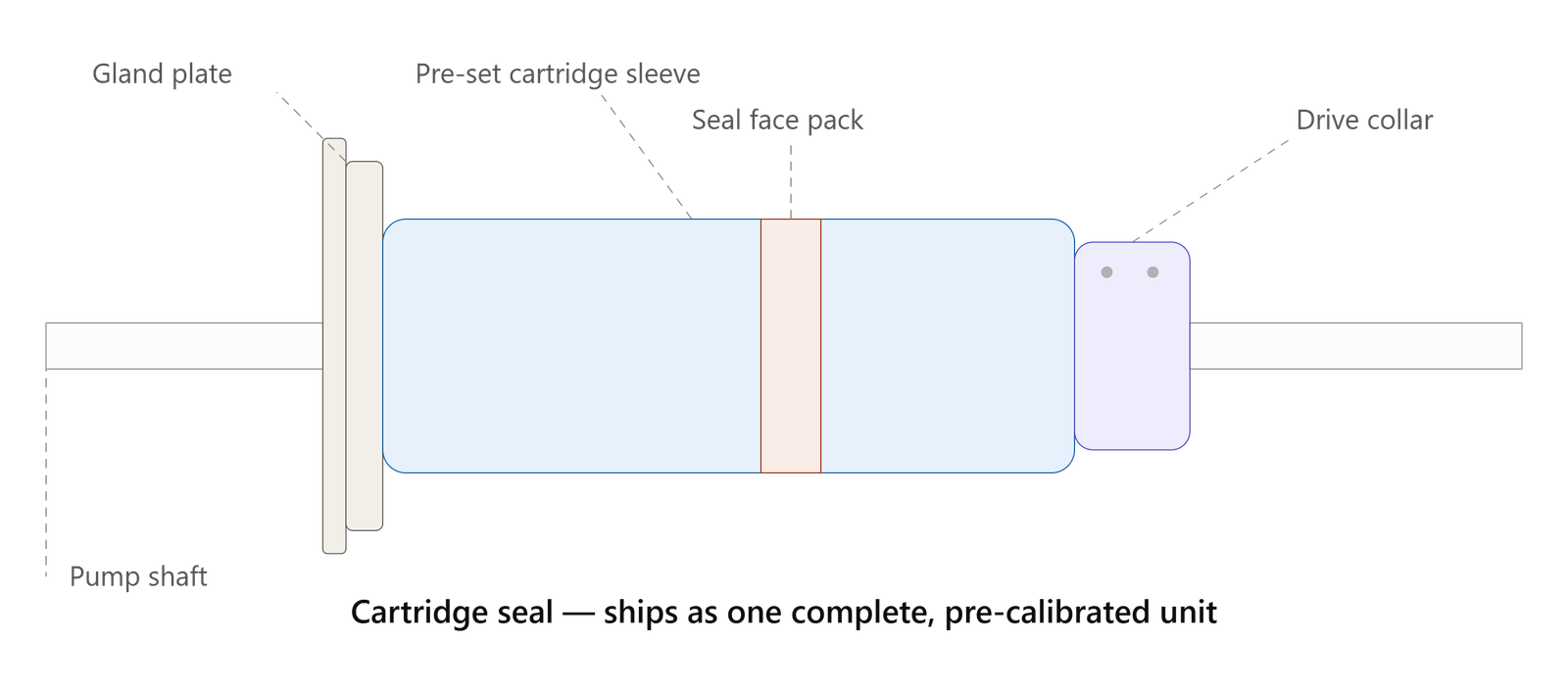
A cartridge seal is a pre-assembled mechanical seal unit that mounts as a single piece onto a pump shaft, cutting installation time and removing the guesswork that comes with fitting individual seal components. As a cartridge seal manufacturer, QMSEALS builds these units to exact shaft, sleeve, and gland dimensions so they go straight onto rotating equipment without on-site adjustment or seal-face setting.
What Is a Cartridge Seal?
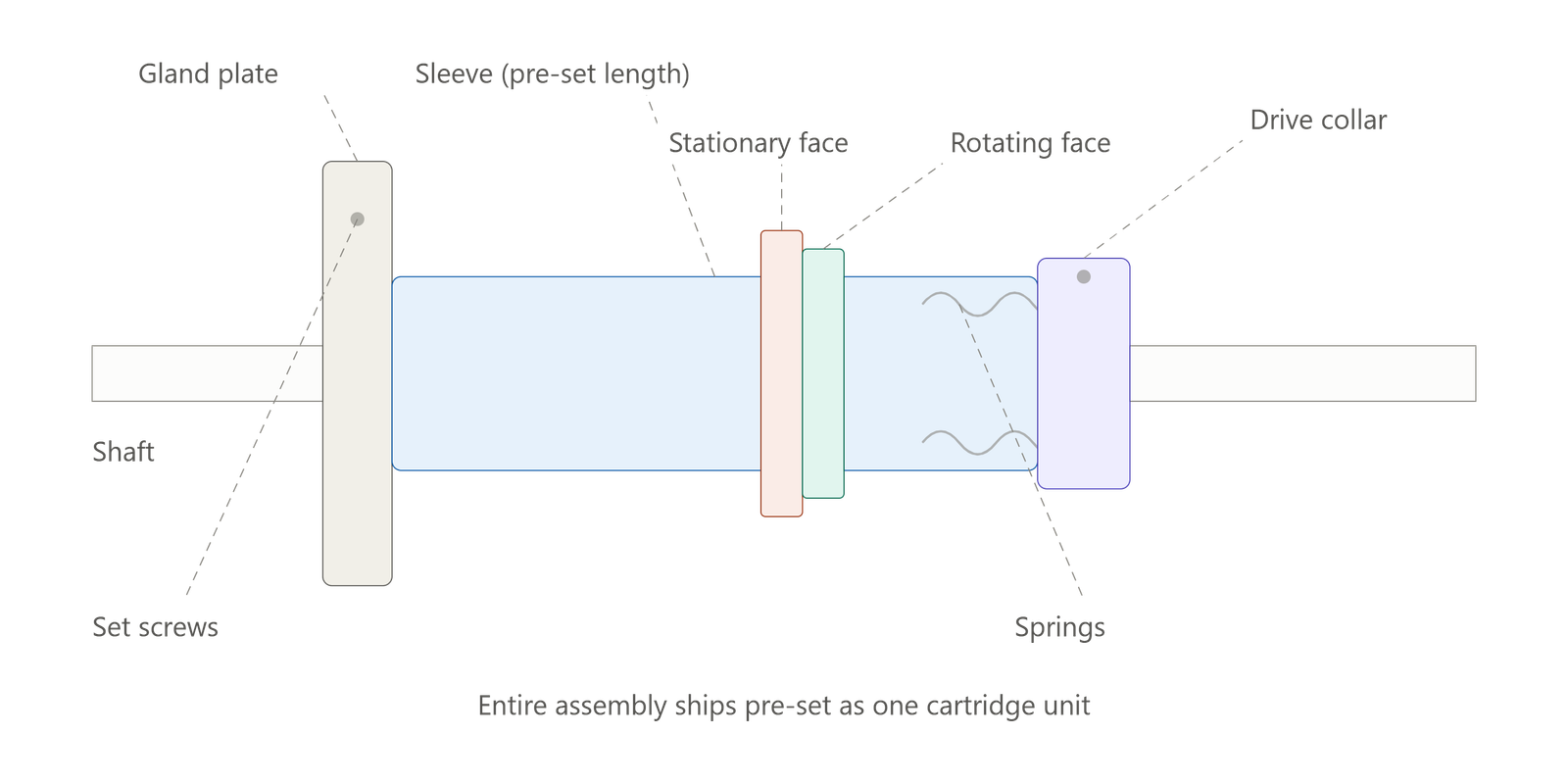
A cartridge seal is a mechanical seal that comes fully assembled on its own sleeve, complete with the gland plate, seal faces, springs, and drive mechanism already fitted and pre-set at the correct working length. Instead of building the seal on the shaft piece by piece, the whole unit slides on as one component and is locked into position with set screws.
This pre-assembly is what separates a cartridge seal from a conventional component seal. There's no need to measure spring compression, align seal faces, or set the working dimension by hand — all of that is done at the factory, under controlled conditions, before the seal ever reaches site. For plants running dozens or hundreds of pumps, that difference adds up to real savings in downtime and rework, which is exactly why most process plants now specify a cartridge design as standard rather than an exception.
How Does a Cartridge Seal Work?
Inside the cartridge, two seal faces — one stationary, one rotating — are held in contact by spring force, creating a thin fluid film that keeps the process fluid inside the pump casing while stopping outside contamination from getting in. The sleeve, gland, and set screws hold the whole assembly at a fixed, pre-calibrated length, so once it's slid onto the shaft and the gland bolts are tightened, the seal is already at its correct operating setting.
Because the setting is done in the factory rather than by a fitter under time pressure, cartridge seals largely remove the most common cause of early mechanical seal failure: incorrect installation. The seal faces run true from the first startup, and the risk of over-compression or misalignment during fitting is essentially eliminated. This installation reliability is one of the main reasons plants standardize on a single cartridge seal manufacturer across their site rather than sourcing component seals from multiple suppliers.
Single Cartridge Seal vs Double Cartridge Seal
QMSEALS manufactures both configurations, and the right one depends on what the seal needs to contain and how critical leak-free operation is for the application.
| Feature | Single Cartridge Seal | Double Cartridge Seal |
|---|---|---|
| Seal faces | One pair | Two pairs |
| Barrier/buffer fluid | Not required | Required (barrier fluid circulates between the two seals) |
| Best for | Standard fluids, non-hazardous duty | Toxic, flammable, or high-purity fluids |
| Leakage risk | Direct atmosphere exposure on failure | Backed up by the second seal — near-zero emission |
| Typical use | Water, mild chemicals, general process pumps | Hydrocarbons, hazardous chemicals, pharma, food-grade |
A single cartridge seal handles most standard-duty pumps reliably and at lower cost. A double cartridge seal is the right call whenever the fluid is dangerous to release to atmosphere, or where plants follow API 682† — the American Petroleum Institute's standard for pump shaft sealing systems — which calls for zero-emission sealing on hazardous duty. The barrier fluid between the two seal faces means the process fluid never has a direct path out, even if the primary seal face wears.
Materials Used in Cartridge Seal Construction
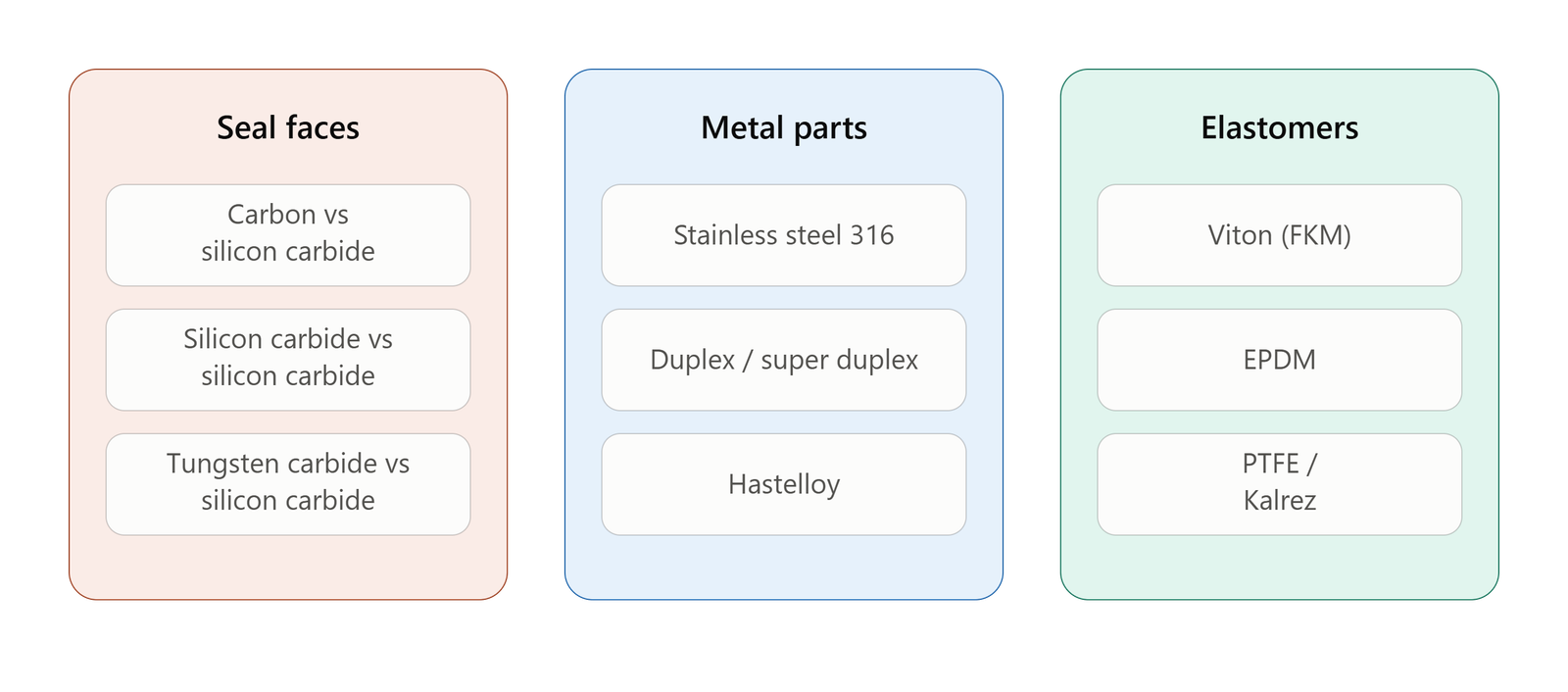
Seal face and elastomer selection depends on the fluid being handled, its temperature, and how abrasive or corrosive it is. QMSEALS builds cartridge seals across the following material combinations:
Seal Faces
- Carbon vs Silicon Carbide — general-purpose, cost-effective, good for clean-to-mildly-abrasive service
- Silicon Carbide vs Silicon Carbide — high hardness, excellent for abrasive slurries and hot water
- Tungsten Carbide vs Silicon Carbide — heavy-duty combination for high-pressure and high-speed applications
Metal Parts
- Stainless Steel 316 — standard corrosion-resistant construction for most industrial fluids
- Duplex / Super Duplex — for higher chloride content and more aggressive chemical environments
- Hastelloy — for strongly corrosive or high-temperature chemical duty
Elastomers / Secondary Seals
- Viton (FKM) — broad chemical resistance, standard choice for most process fluids
- EPDM — suited to hot water, steam, and caustic service
- PTFE / Kalrez — for aggressive chemicals and high-temperature applications where elastomers would degrade
Applications & Industries
QMSEALS cartridge seals are used across rotating equipment wherever reliable, low-maintenance sealing is required:
- Centrifugal & process pumps — chemical, water, and general industrial transfer
- Agitators & mixers — agitator seals for reactor vessels in chemical and pharma plants
- Reactors & dyeing machines — textile and process industries
- Compressors — gas and vapor handling
- Power plants — boiler feed and condensate pumps
- Pharmaceutical & food processing — hygienic, high-purity sealing requirements
- Oil & gas — refinery and petrochemical rotating equipment
Why Choose QMSEALS as Your Cartridge Seal Manufacturer
Pre-set, ready-to-install units — every cartridge seal leaves our facility already calibrated to the correct working length, so installation on site is a straightforward slide-and-bolt job.
Custom-built to your equipment — we manufacture to your pump, mixer, or reactor drawings, or reverse-engineer from a sample seal or OEM part number, similar to our approach on OEM mechanical seal manufacturing.
Full material range — carbon, silicon carbide, tungsten carbide, stainless steel, duplex, and Hastelloy construction, with Viton, EPDM, and PTFE elastomer options.
15+ years of manufacturing experience — serving more than 2,000 clients since 2009, with seals running in plants across India, Dubai, Saudi Arabia, Vietnam, Qatar, Philippines, Indonesia, Thailand, Bangladesh, and African countries — see our full list of exporting countries.
In-house quality control — every seal is bench-tested before dispatch, with raw materials sourced to meet global industry standards such as API 682†.
Refurbishment service available — beyond new manufacturing, we also recondition worn seals, including cartridge units originally made by other manufacturers, back to original performance.
On-time support — CRM-backed order tracking keeps clients updated from order confirmation through to dispatch, with technical support available for installation guidance.
As a trusted cartridge seal manufacturer, QMSEALS also supplies related sealing components — including lantern rings, seal pots, and gaskets — so plants can source their full sealing system from one place.
Looking for a reliable cartridge seal manufacturer for your pumps or rotating equipment? Request a Free Quote and our engineering team will get back to you with a matched recommendation.
Frequently Asked Questions
What is the difference between a cartridge seal and a component seal?
A cartridge seal comes pre-assembled on its own sleeve with the gland, faces, and springs already fitted and set to the correct working length. A component seal is built up piece by piece directly on the shaft, requiring the fitter to measure and set the spring compression manually during installation. Cartridge seals are faster to install and far less prone to setup error.
Do cartridge seals require special training to install?
No. That's the main advantage of a cartridge seal — since it's pre-set at the factory, installation only involves sliding the unit onto the shaft, aligning it, and tightening the gland bolts and set screws. No seal-face setting or spring measurement is needed on site.
When should I use a double cartridge seal instead of a single?
Use a double cartridge seal whenever the fluid being pumped is hazardous, flammable, toxic, or must meet zero-emission requirements under standards like API 682. The second seal, backed by a circulating barrier fluid, ensures the process fluid never has a direct path to atmosphere even if the primary seal face wears.
Can QMSEALS manufacture a cartridge seal for my existing pump?
Yes. Send us your pump make and model, or your existing seal's dimensions and part number, and we'll manufacture a matched cartridge seal — including for OEM equipment such as Grundfos, KSB, Flowserve, and Kirloskar pumps.
What materials should I choose for a corrosive or abrasive fluid?
For abrasive slurries, silicon carbide vs silicon carbide faces hold up best. For corrosive chemicals, Hastelloy or duplex stainless metal parts combined with PTFE or Kalrez elastomers offer the strongest resistance. Share your fluid details with our team and we'll recommend the right combination.
How long does it take to get a custom cartridge seal manufactured?
Lead time depends on size and material availability — standard configurations typically ship faster than fully custom builds. Share your requirement through our quote form and we'll confirm exact lead time along with pricing.

